How Much Sun Does Your Garden Get? Measure It, Don’t Guess
Too little light is one of the most common reasons a healthy plant fails. Here’s how to find out whether a spot is really full sun, part sun or shade, and how that changes through the year.
Every plant tag is a claim about hours
“Full sun”, “part sun” and “part shade” sound vague, but they mean specific amounts of direct sunlight per day. Bright shade under a porch roof doesn’t count, and neither does daylight. What counts is the time the sun itself shines on the spot.
See it measured in 40 seconds

Does your garden bed really get full sun? Measure it with your iPhone · 0:40
The free way: watch it hour by hour
The classic method works and costs nothing. Pick a clear day, go out every hour from sunrise to sunset, and note whether the spot is in sun or shade. Add up the sunny hours.
It has three problems:
- It takes the whole day. And it has to be sunny.
- It’s only true for that day. Measure in May and you know nothing about August or October.
- You can only check a few spots. Comparing the side yard, the back fence and the patio means three days of notes.
The fast way: trace the sky once
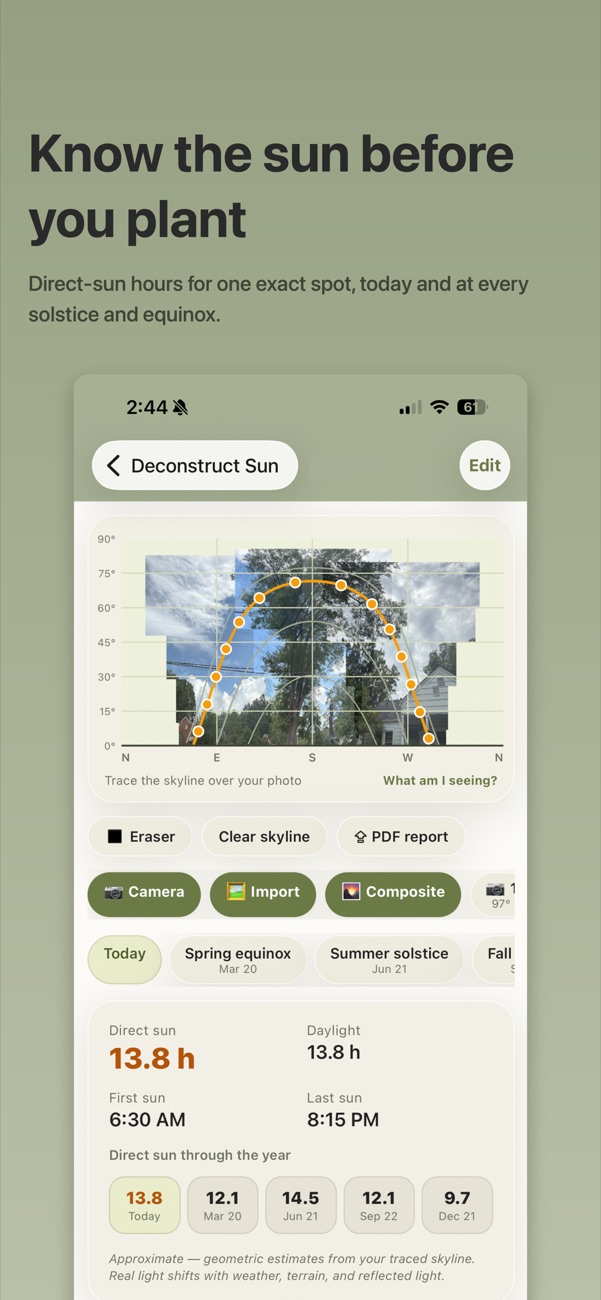
The sun’s path is completely predictable. What’s unknown is what blocks it at your spot. If you capture the skyline of trees, roofs and fences around you once, the hours for any day of the year follow from geometry.
That’s what Deconstruct Sun does. Stand at the spot, paint or photo-trace the skyline, and it checks the sun against it every five minutes. You get the direct-sun hours for today, both solstices and both equinoxes in a few minutes.
Find the sunniest spot in your yard
Free on iPhone: sun hours for any spot you stand on, plus your hardiness zone.
Why sun changes so much by season
In June the sun rises in the northeast, climbs high and sets in the northwest. In December it rises in the southeast, stays low and sets in the southwest. In most of the US the winter noon sun is only 25–35° above the horizon, so a 20-foot tree to the south casts a noon shadow 30–45 feet long.
Two things follow. A bed that’s full sun in summer can be shade by October. And the north side of a house that’s shady all winter can get a few hours of direct sun in midsummer, early and late in the day.
Deciduous trees help: once leaves drop, winter sun comes through the branches. If you trace a skyline in summer with the trees in leaf, read the winter numbers as the shadiest case. See your local sun path with the free sun calculator.
How much sun vegetables and herbs need
| Crop | Direct sun per day |
|---|---|
| Tomatoes, peppers, eggplant | 8+ hours |
| Squash, cucumbers, melons, corn, beans | 6–8+ hours |
| Carrots, beets, potatoes, onions | 6 hours |
| Basil, rosemary, thyme, oregano | 6+ hours |
| Peas, broccoli, cabbage | 6 hours (some shade in heat) |
| Parsley, cilantro, mint, chives | 3–4+ hours |
| Lettuce, spinach, kale, chard, arugula | 3–4 hours |
General guidance. In hot southern summers many crops welcome afternoon shade.
Morning sun vs. afternoon sun
Afternoon sun is hotter than morning sun. That’s why part-shade plants like hydrangeas, hostas and ferns usually want morning sun and afternoon shade, and why an east-facing bed with 5 hours of sun is gentler than a west-facing one with the same hours. Deconstruct Sun shows when the first and last direct sun arrive, not just the total.
Don’t forget the zone
Light decides whether a plant thrives. Your hardiness zone decides whether it survives winter. Look up yours with the hardiness zone finder, or see it in the app for each spot.
Questions
How many hours of sun do vegetables need?
Fruiting crops like tomatoes, peppers, squash, cucumbers and corn need full sun: at least 6 hours and ideally 8 or more. Root crops do best with 6. Leafy greens and many herbs get by on 3–4 hours, and in hot climates they appreciate afternoon shade.
Does morning sun or afternoon sun count more?
An hour is an hour for the count, but afternoon sun is hotter. Part-shade plants such as hydrangeas and hostas usually do best with morning sun and afternoon shade. Sun lovers handle the afternoon heat.
Does dappled shade count as sun?
Not as direct sun. Light filtering through a high, open tree canopy helps more than solid shade, so a spot with 3 hours of sun plus dappled light can grow more than its hour count suggests. Count the direct hours and treat dappled light as a bonus.
Why did my sunny bed get shady in fall?
The sun’s path drops lower every day from June to December. Trees and buildings that sat below the summer sun start blocking it, and shadows get much longer. Deconstruct Sun shows the same spot at the solstices and equinoxes, so you can see the change before you plant.
Do I need the paid version?
No. The free app measures today’s direct-sun hours from a skyline you paint by hand, and shows your hardiness zone. Pro ($11.99, one time) adds tracing over photos, which is more accurate, and the full-year breakdown.

Know the sun before you plant.
Free on iPhone. Pro is a one-time $11.99, no subscription.